llama.cpp
Introduction
llama.cpp is a high-performance, open-source project written in C/C++. Its primary goal is to run large language models locally on consumer-grade hardware, with a particular focus on CPUs. Originally developed by Georgi Gerganov for efficient inference of Meta's LLaMA models, it has since expanded to support a wide array of other open-source models.
Core Features:
- Pure CPU Inference: Its standout advantage is the ability to run multi-billion parameter models using only the CPU and system RAM, without requiring powerful discrete GPUs. This dramatically lowers the barrier to entry for local AI deployment.
- Extreme Performance & Quantization: The project employs highly optimized computation kernels (e.g., AVX2, AVX-512) and actively promotes model quantization. By compressing model weights from FP16 down to 4-bit or lower precision, it significantly reduces memory footprint and boosts inference speed with minimal loss in quality.
- Lightweight & Cross-Platform: The project has minimal dependencies and compiles into a compact executable. It supports multiple operating systems including Windows, Linux, and macOS, and can even run on embedded devices like Raspberry Pi and smartphones.
- Rich Ecosystem & Interfaces: Beyond basic command-line interaction, it provides:
- An OpenAI-compatible HTTP API server for easy integration with other applications.
- Support for Web UI and GUI clients, offering user-friendly chat interfaces.
- Integration with AI application frameworks like LangChain.
- Open Model Format: It pioneered and popularized its own model file format, GGUF. The GGUF format is optimized for llama.cpp's inference engine, bundling model architecture, weights, tokenizer, and quantization information into a single, easy-to-distribute and load file.
Typical Use Cases:
- Running a local chatbot assistant on a GPU-less personal computer (laptop, desktop).
- Offline document processing, code completion, or creative writing in privacy-sensitive environments.
- Providing developers with a lightweight, efficient backend for integrating AI features into their applications.
- Experimenting with and researching the latest open-source LLMs without expensive cloud computing resources.
Significance: llama.cpp is a landstone in the democratization of large language models. By breaking the dependency on specialized hardware for running LLMs, it empowers anyone with a standard computer to experience and control powerful AI locally. It has profoundly accelerated the adoption and innovation of open-source AI at the edge.
Generated by AI
Image
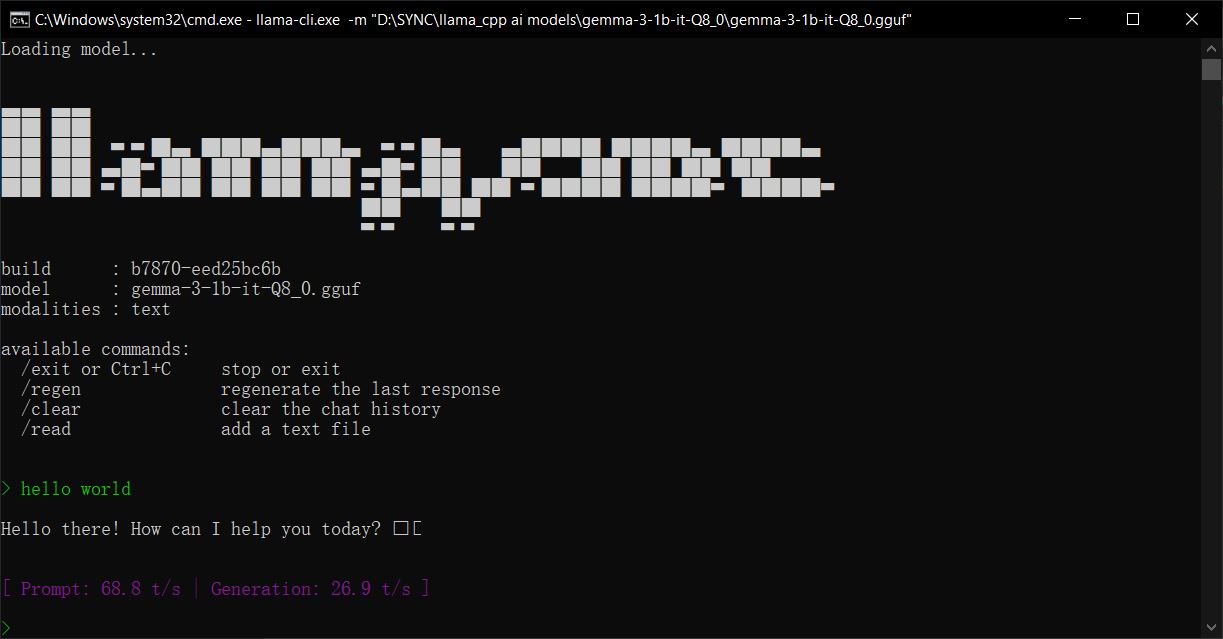
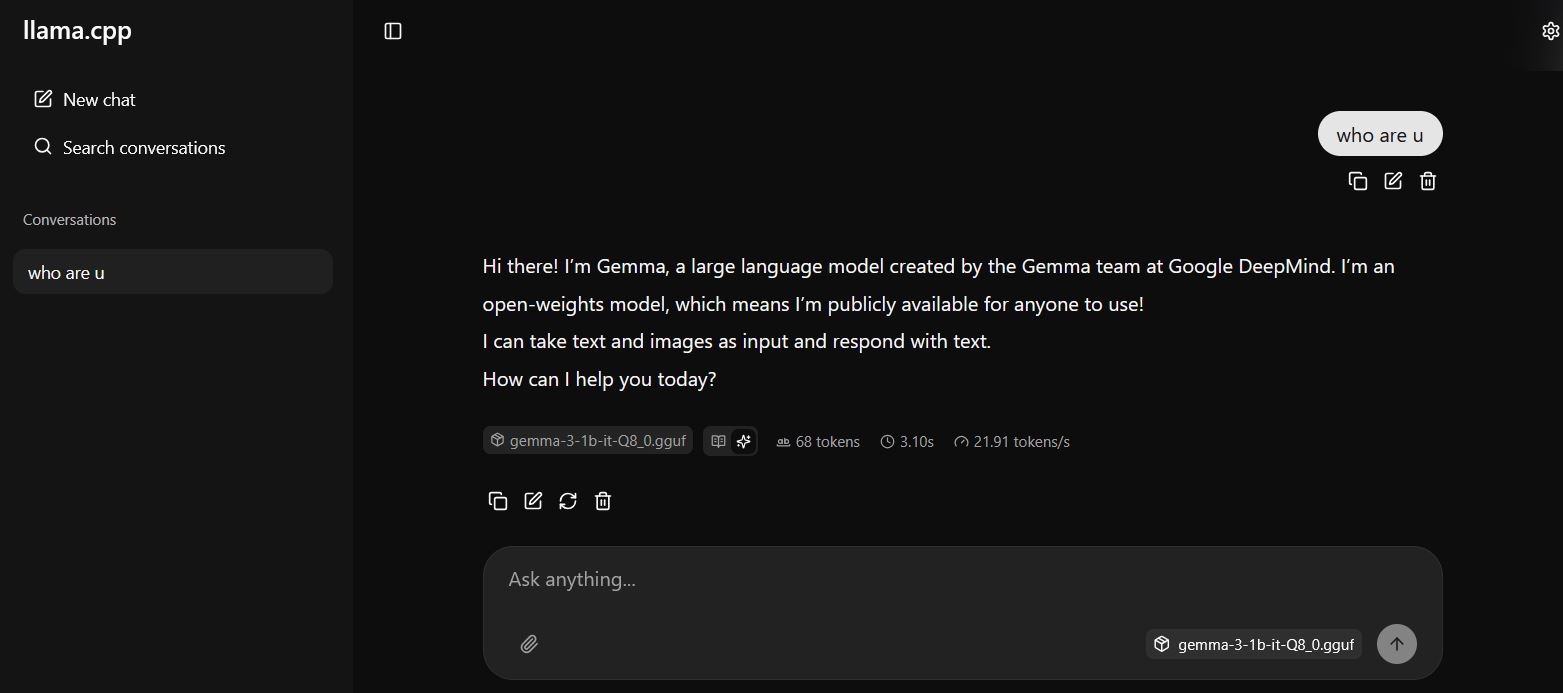
Get
Available on github:https://github.com/ggml-org/llama.cpp
Direct Download:
llama.cpp:65d19c72-5d3b-4c4f-a44a-ad717c4d20d4
some models:0a27079f-a53c-46f5-b149-75cfb09303a8
Having trouble downloading?
If you encounter any issues during the download process, refer to the following solutions:
Link invalid or incorrect How to download the ed2k link How to download the magnet/torrent file Other problemsNote
You need to install the latest version of the VC runtime in order to run llama.cpp. You can download it here:https://learn.microsoft.com/en-us/cpp/windows/latest-supported-vc-redist?view=msvc-170#latest-supported-redistributable-version
The Vulkan version of llama.cpp can use the GPU for acceleration. You can use the --gpu-layers parameter to determine how many layers are handled by the GPU, for example, --gpu-layers 18. If your video memory is not sufficient, try adjusting to a smaller number.
Models like gemma4 have reasoning capabilities. If you need to disable reasoning, you can add the following to the startup parameters: --chat-template-kwargs "{"enable_thinking": false}"
In the web UI, click on Settings, and in SystemMessage you can set system prompt words, which will affect the tone and perspective of the responses.